
“We’re not policymakers; we’re winemakers.”
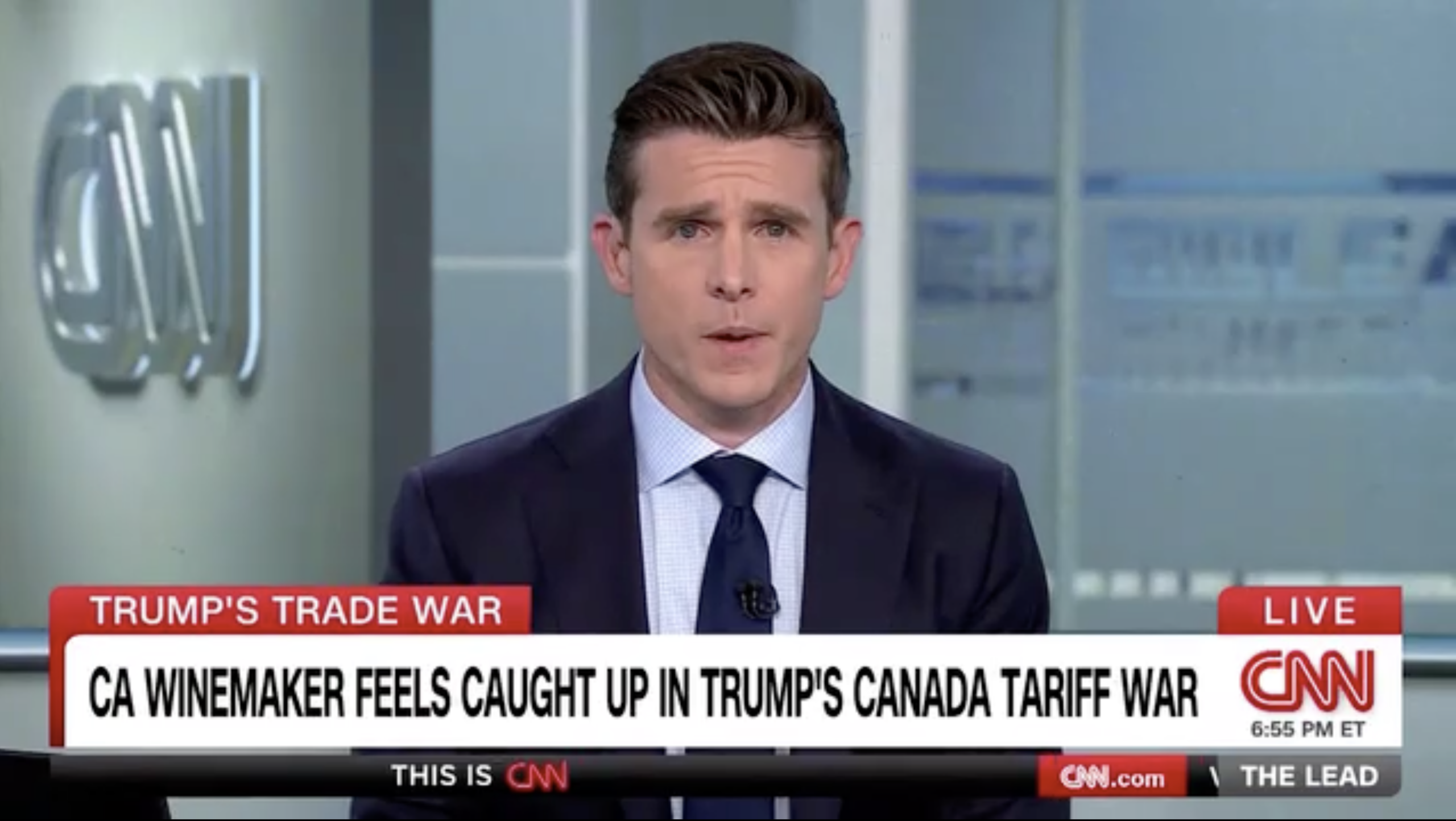
Recently, I was featured in both the Wall Street Journal and on CNN to discuss US-Canadian Trade Relations and their impact on the wine industry. You can find links to our media appearances here at the Trade & Press page, but I want to take a moment now to flesh out my thoughts on the situation more completely. While some have criticized me for not taking a stronger stance against the present administration, or Canada, in taking any position on the issue, my goal throughout has been to portray and maintain a balanced and constructive tone as an artisanal producer who has been affected by the trade war and its consequences. The points that I believe are relevant to the issue are these:
- First, at its finest, wine is a living agricultural product grown and produced by (generally) small family farms, not an industrial bargaining chip.
- Second, the trade dispute with Canada, our closest neighbor, has inflicted economic, political, and personal hardship on both sides of the border, including restaurants, wine importers, and retailers, as well as family-owned U.S. wineries.
- Third, and finally, our goal as a boutique producer is to de-escalate the political rhetoric and to reengage our many wonderful customers in Canada, especially a time when the wine industry is facing broader economic headwinds.
In general, we support free trade and open markets in the wine industry and across the border. We require inputs from the rest of the world – glass bottles designed in France and fabricated in Vietnam or Mexico, cork from Portugal, and French oak are the major examples – and we do need to be able to sell and ship our wines freely to those same markets. The US alone does not provide the raw materials we need to produce wine, nor is it the only market for our products.
As a small family business, and a winery, it has been my position since we started Crosby Roamann not to take a position on political issues. The rule was reinforced during the 2016 primary elections at a members’ tasting event, when two friends and wine club members ended the evening in a furious debate over Hillary Clinton and Bernie Sanders. It created an uncomfortable situation for our team and an unpleasant environment for our other guests. Since then, as hosts and business owners, we have maintained a strict policy of keeping partisan politics out of our tasting room.
The trade dispute is different. Historically, Canada has been the single largest buyer of American wines outside of the US, accounting for roughly $400 million in annual wine sales (according to industry trade data), and the Liquor Control Board of Ontario (“LCBO”) itself is one of the largest wine buyers in the world. Our winery, working with our broker – Gibson Family Group in Toronto – historically sold between 5% and 10% of our annual production to the LCBO in any given year. We have also sold wine into Alberta, specifically for the Calgary market. And importantly, American wine accounts for the top dollar-value share in key markets like Ontario. It is an incredibly good and historically important market for us, and we enjoy sharing our wines with our many great and loyal customers in Canada.
This represents a deeply interconnected relationship: Canada is our primary international destination, and American wine has long held a central place on Canadian tables.
That does not mean trade between our two nations was seamless before the current dispute. The reality is that exporting to Canada has always involved significant structural friction. The LCBO operates one of the world’s largest government alcohol monopolies—an inherently costly and centralized system. By the time our bottles reach Toronto retail shelves, their prices have more than doubled. The LCBO applies a base markup of roughly 70% to 73% on wholesale landed cost, but once flat fees, environmental levies, federal excise duties, and sales taxes are compounded, the effective markup from our winery cost to the Canadian retail shelf routinely reaches 100% to 140% or more.
Another point of contention is the illegality of wine shipping to Canada as a whole. Let me be clear: It is illegal for an American winery, or any winery outside of Canada for that matter, to sell and ship wine to a Canadian address.
Consider a common scenario: a Canadian visitor falls in love with our wines in our Napa tasting room and asks us to ship a case to her home in Calgary or Toronto. Under current regulations, an American winery cannot simply mail a box directly to a consumer’s doorstep. Unlike shipping to foreign markets like the UK or Japan, where established personal-use import frameworks exist, shipping to Canada requires navigating strict provincial monopoly oversight, consignment protocols, and compounding tariffs. Ironically, it is easier for us to ship a bottle of Napa Cabernet to a customer in London or Tokyo than to our closest neighbor across the northern border.
We can, however, sell and ship wine to most other foreign democracies in the world as a Fedex International Wine Shipper. By contrast, Fedex does offer a “specific mechanism for Canadian shipping” across Alberta, British Columbia, Ontario, and Quebec. Shipments may be sent “In Care / Of” or “C/O” to the provincial liquor authority (e.g., the LCBO) where a consumer could in theory pick up their DTC wine shipment and pay the hefty duty on their purchase of wine directly to the regulator, but the fact of the matter is, this does not happen in practice, and is not generally practicable nor commercially feasible. Such shipments are usually stopped at the border, inspected, and returned to the shipper as “undeliverable.”
The point of the matter is, while most of the developed world, and most of America’s closest trading partners, are generally open for wine shipping, even with increased fees, taxes, and miscellaneous costs, Canada is not. That’s something worth discussing.
We’re not policymakers; we’re winemakers. Trade disputes happen – we understand that as an industry – and here in Napa Valley, we are resilient. We recognize that trade representatives in Washington D.C. are negotiating multi-billion-dollar deals that often extend far beyond our chosen sphere of influence: the fermented juice of grapes.
Even so, over the past two years, winemakers have watched costs surge on imported French oak barrels, glass bottles designed in France and manufactured in Mexico, China, or Vietnam, and natural cork imported from Portugal and Spain. None of these raw materials are available at scale in the U.S.
These cost increases significantly impact our bottom line, occurring precisely as global wine consumption sits at a 60-year low and American consumption has fallen to levels not seen since the Global Financial Crisis. Compounded by market conditions that prevent us from passing these costs onto consumers, boutique wineries face an increasingly tenuous operating environment.
The message for our trade representatives is clear: Keep talking. Do not walk away from the table. Work out a solution. Constituents on both sides of the border want a deal done, because leaving American wine effectively prohibited in Canada helps no one. Only through resolution can American wineries re-engage our loyal Canadian customers and return to dinner tables across the provinces and territories of Canada.
To everyone who enjoys wine, my concluding message is simple: If you love wine and want to support American small businesses, this is a critical time to do so. Support your favorite American winery, wherever it may be. Come visit us here in Napa Valley and across California. We are eager to welcome you and share our passion for handmade, boutique wines.


